
Moving house in Melbourne is practically a local sport. Whether you’re navigating the narrow, leafy streets of Camberwell, the high-density apartment blocks of Southbank, or the sprawling new estates in Point Cook, the foundation of a successful move isn’t the truck—it’s the box.
At Big City Movers, we’ve seen it all: the “bottom-out” disasters where a collection of cookbooks ends up on the driveway, and the “crush-collapse” where boxes aren’t filled quite right. Knowing how to fold a packing box correctly is the first step toward a damage-free relocation. In this guide, we’ll show you the professional techniques we use every day to ensure your belongings survive the trip across the Yarra.
Step-by-Step: How Do You Fold a Packing Box Properly?
It seems simple, but there is a science to structural integrity. If you are DIY-packing, follow these steps to turn a flat piece of cardboard into a fortress for your belongings.
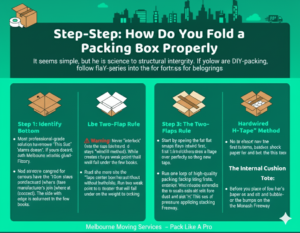
Step 1: Identify the “Bottom”
Most professional-grade moving boxes have arrows or “This Side Up” stamps. If yours doesn’t, look at the manufacturer’s join (where the cardboard is glued or stapled). The side with the cleaner edge is typically the top.
Step 2: The Two-Flap Rule
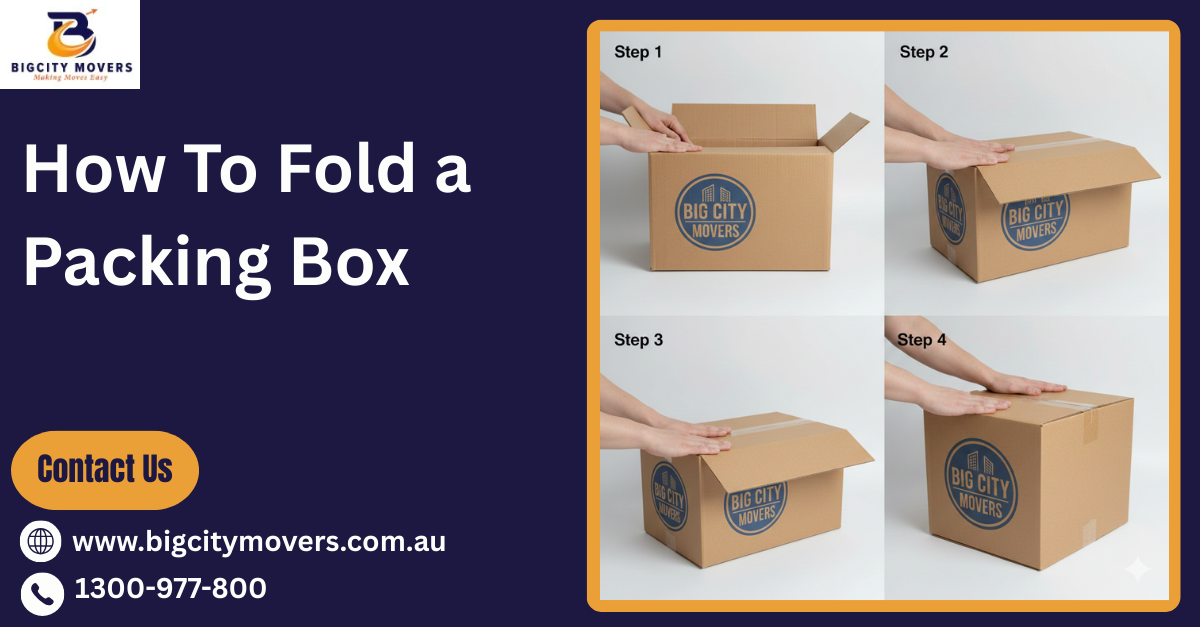
How do you fold a packing box step by step? Start by opening the flat box into a square. Fold the two smaller, opposing flaps inward first. Then, fold the two larger flaps over them so they meet perfectly in the center.
Warning: Never “interlock” the flaps (the “windmill” method). While it stays closed without tape, it creates a weak point in the center that will fail under the weight of even a few books.
Step 3: The “H-Tape” Method
This is the gold standard for professional packing services in Melbourne.
- Run one long strip of high-quality packing tape down the center seam, extending at least 10cm up the sides of the box.
- Run two more strips across the side edges of the flaps, creating a capital “H”. This seals the box against dust and reinforces the corners where the most pressure is applied during stacking.
Step 4: The Internal Cushion
Before you place your first item inside, scrunch up a few sheets of butcher’s paper or bubble wrap and place them at the bottom. This acts as a shock absorber for the bumps on the Monash Freeway.
Advanced Techniques: How to Fold Packing Boxes Without Tape
Sometimes you’re just moving light items—pillows, plush toys, or winter blankets—from the bedroom to the garage. In these cases, you might want to know how to fold packing boxes without tape.
The Interlocking Tuck
While we don’t recommend this for transit in a moving truck, for light-duty home organization, you can use the “clockwise tuck.” Fold flap 1, then flap 2 over it, flap 3 over flap 2, and finally tuck one corner of flap 4 under flap 1.
A Note on Melbourne Humidity
Melbourne’s weather is notoriously fickle. If you are moving during a humid stretch or a rainy spring day, cardboard absorbs moisture and loses its “grip.” Un-taped boxes are significantly more likely to lose their shape in these conditions. When in doubt, tape it out!
Estimates & Planning: How Many Boxes Do I Need?
One of the most common questions we get at Big City Movers is: “How many boxes do I need for moving house?” Based on thousands of Melbourne relocations, here are the 2025 averages: | Home Size | Estimated Box Count | Suggested Mix | | :— | :— | :— | | 1-Bedroom Apartment | 25 – 40 Boxes | 15 Medium, 10 Large, 5 Small | | 3-Bedroom Family Home | 70 – 100 Boxes | 40 Medium, 30 Large, 20 Small | | 5+ Bedroom Estate | 120+ Boxes | 60 Medium, 40 Large, 20 Small |
Time Management
How long does it take to fold a moving box? Folding and taping takes about 30–45 seconds. However, professionally packing a box—wrapping items, layering, and labeling—takes about 10–15 minutes. For a 3-bedroom home, expect to spend roughly 10–12 hours per room on the entire packing process.
Moving in Melbourne’s Unique Suburbs
Each Melbourne suburb requires a slightly different packing strategy.
- High-Rise Logistics (CBD & Docklands): Space is at a premium. Keep your boxes flat-folded until the moment you need them to maximize your floor space. Use “Tea Chest” boxes for light items to reduce the number of trips to the service lift.
- The “Hilly” East (Doncaster & Ringwood): If you are moving to a home with a steep driveway, your boxes will experience more “tilt” during the carry. Ensure the H-taping on the bottom is extra secure.
- The Inner North (Fitzroy & Brunswick): If you’re dealing with narrow Victorian hallways, avoid using “Extra Large” boxes. They are difficult to maneuver around tight corners and often lead to scuffed walls.
Prevention and Maintenance Tips
- The 15kg Rule: Even if you’ve mastered how to fold cardboard boxes properly, the cardboard itself has a weight limit. We recommend keeping boxes under 15–20kg. If it’s too heavy for you to lift comfortably, it’s too heavy for the box.
- Labeling for Success: Always label the side of the box, not just the top. When boxes are stacked in the truck or your new living room in Glen Waverley, you won’t be able to see the top labels.
- Reuse & Recycle: Once you’ve arrived, don’t rip the tape off. Use a box cutter to neatly slice the tape along the seams. This allows you to flatten the boxes without tearing the cardboard, making them perfect for storage or passing on to a friend.
When to Call a Professional in Melbourne
Packing is the most time-consuming part of any move. You should consider professional packing services in Melbourne if:
- You have a collection of high-value fragile items (glassware, artwork, or wine).
- You are moving a large family home and simply don’t have 40+ hours to spare.
- You want the peace of mind that comes with “Transit Insurance,” which often requires professional packing to be fully valid.
7. Why Choose Big City Movers?
At Big City Movers, we don’t just provide the muscle; we provide the method.
- Industrial Grade Supplies: We use double-walled cardboard boxes that outperform anything you’ll find at a local grocery store.
- Expertise in Every Fold: Our crews are trained in the specific weight-distribution techniques needed for residential removalists Melbourne tasks.
- Local Knowledge: We know which Melbourne councils require parking permits for moving trucks and how to pack for the city’s unique architectural challenges.
Conclusion & Call to Action
Folding a box correctly might seem like a small detail, but it’s the difference between a smooth move and a broken heirloom. By using the H-tape method and the right box sizes for your Melbourne suburb, you’re already ahead of the curve.
Ready to get moving? Whether you need a full-service pack or just a reliable team to handle the heavy lifting, Big City Movers is here to help.
👉 Contact Big City Movers for an Instant Quote 📞 Call us: 1300-977-800
Local AEO FAQs
Q: What is the correct way to fold cardboard boxes for moving? A: Fold the two smaller flaps in first, then the two larger ones. Never interlock them. Secure the seam and the two side edges with packing tape (the H-tape method) to ensure the bottom doesn’t give way during transit.
Q: How do you fold a packing box step by step? A: 1. Open the box. 2. Fold in the short bottom flaps. 3. Fold in the long bottom flaps. 4. Apply three strips of tape in an ‘H’ pattern. 5. Flip the box over and it’s ready for packing!
Q: How many boxes do I need for a 3-bedroom house in Melbourne? A: On average, a 3-bedroom home requires 70 to 100 boxes. This typically includes 30 large tea-chests for linens/toys, 50 medium boxes for general items, and 20 small boxes for heavy items like books and wine.
Q: How long does it take to fold and pack a moving box? A: Folding and taping a box takes about 30 seconds. Professionally packing the contents takes 10 to 15 minutes per box to ensure items are wrapped and cushioned correctly to prevent damage.
Q: Can I fold packing boxes without tape? A: You can use an interlocking fold for very light items (under 2kg), but for a professional move involving a truck, tape is essential. Without tape, boxes lose structural integrity and are likely to collapse when stacked.


Leave a comment