
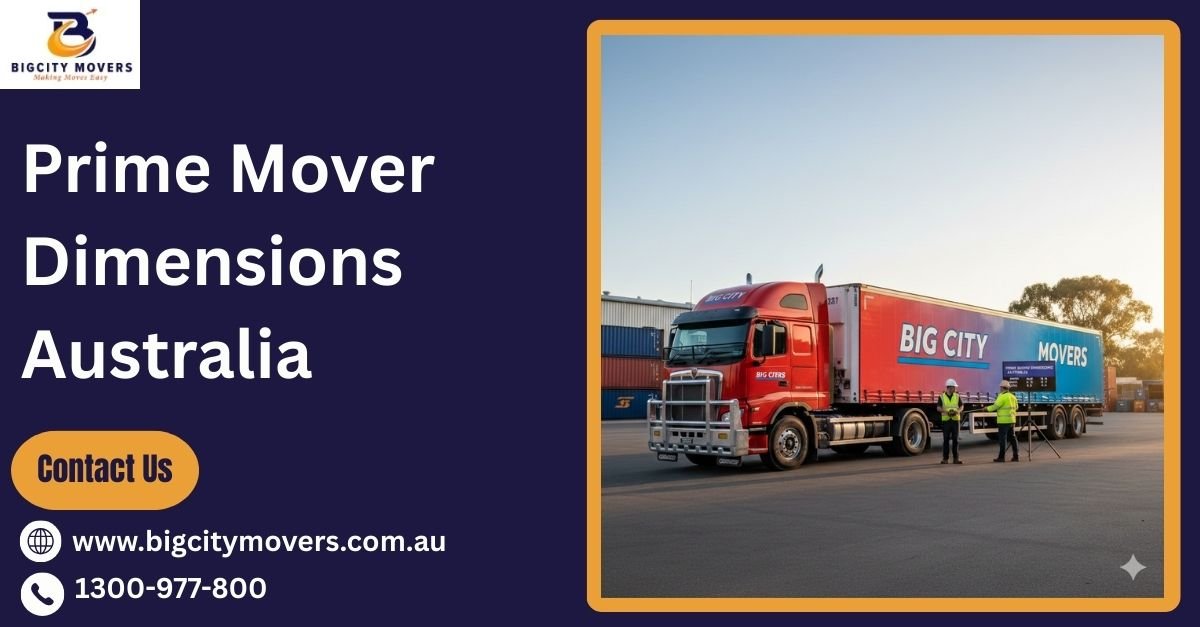
Whether you are planning a massive commercial relocation through the Bolte Bridge or moving an entire manufacturing line from Dandenong to the Inner West, the first question you need to answer is: “Will it fit?”
Understanding prime mover dimensions in Australia is not just about logistics—it is about legal compliance and public safety. Navigating Melbourne’s unique blend of narrow heritage streets and high-tech toll roads requires precise knowledge of height, width, and length. At Big City Movers, we deal with these measurements every day to ensure our clients’ largest assets move smoothly across Victoria.
Prime Mover Dimensions in Australia
In 2025, the standard prime mover dimensions in Australia are strictly regulated by the National Heavy Vehicle Regulator (NHVR). A standard prime mover unit typically has a width of 2.5 metres and a height cap of 4.3 metres. While the length of the prime mover itself is usually between 6 and 7.2 metres, the total combination length (prime mover plus a standard semi-trailer) is legally limited to 19 metres for general road access. For high-volume moves, B-double combinations can reach up to 26 metres on approved Victorian freight networks.
Standard Australian Prime Mover Dimensions Breakdown
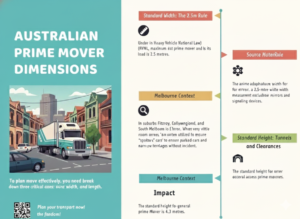
To plan a move effectively, you need to break down the three critical axes: width, height, and length.
Standard Width: The 2.5m Rule
Under the Heavy Vehicle National Law (HVNL), the maximum width for a prime mover and its load is 2.5 metres. This measurement excludes rearview mirrors and signaling devices.
- Melbourne Context: In suburbs like Fitzroy, Collingwood, and South Melbourne, a 2.5-metre width leaves very little room for error. When we manage moves in these areas, we often utilize “spotters” to ensure the truck navigates parked cars and narrow terrace frontages without incident.
Standard Height: Tunnels and Clearances
The standard height for a general access prime mover is 4.3 metres.
- The 4.6m Exception: Certain specialized trailers, such as those built for livestock or multi-deck vehicle transport, are permitted to operate at 4.6 metres on designated “high-productivity” routes.
- Warning: Height is the most dangerous dimension in Melbourne. With our city’s extensive rail network, low-clearance bridges are everywhere.
Standard Length: The “19-Metre” Foundation
- Prime Mover (Solo): Typically 6.0m to 7.2m.
- Semi-Trailer Combination: 19.0 metres (This is the most common setup for large residential moves).
- B-Double: 25.0 to 26.0 metres (Commonly used for commercial moving in Melbourne).
- Pro Tip: As of late 2025, new regulations have proposed increasing certain general access lengths to 20 metres to accommodate safer, more aerodynamic “Euro VI” cab designs.
Local Melbourne Scenarios: The Challenges of a Big City
Navigating a prime mover through Melbourne requires more than a map; it requires local expertise.
The “Montague Street Bridge” Factor
You cannot discuss truck height in Melbourne without mentioning the infamous Montague Street Bridge in South Melbourne. With a clearance of exactly 3.0 metres, it is a “truck-eater” that frequently snags drivers who don’t know their vehicle’s dimensions. In 2025, the Victorian Government reduced the speed limit to 40km/h on the approach to give drivers more time to realize they won’t fit. At Big City Movers, our route planning software automatically flags these low-clearance hazards.
Tunnel Navigation (CityLink & EastLink)
The Burnley and Domain Tunnels have a clearance of 4.65 metres. While a standard 4.3m prime mover fits easily, any “Over-Dimensional” load (like a portable office or heavy machinery) requires a specific permit and often a late-night transit window to avoid the height-detection sensors that can shut down the entire freeway.
Inner-West Truck Bans
Areas like Yarraville and Footscray have strict curfews and “No Truck” zones to protect residential amenity. Knowing the transport truck dimensions Melbourne authorities allow in these zones is the difference between a successful delivery and a $700+ fine.
Compliance and Professional Logistics
To ensure your move is handled with Experience, Expertise, Authoritativeness, and Trust, we follow a rigorous compliance checklist:
- NHVR Journey Planner: Every heavy-duty move we undertake is pre-mapped through the National Heavy Vehicle Regulator’s portal to confirm the route is approved for the specific combination length.
- Swept Path Analysis: For tight construction sites or narrow loading docks in the CBD, we perform a “swept path” check. This ensures a 19m-long vehicle can actually make the turn without hitting the curb or street furniture.
- Front Underrun Protection (FUPS): All our modern prime movers are fitted with FUPS to comply with 26m B-double safety standards.
Cost Considerations for Over-Dimensional Moves
If your equipment or home contents exceed standard dimensions, costs can shift.
- Oversize Permits: Any load wider than 2.5m or taller than 4.3m requires an NHVR permit.
- Pilot Vehicles: In Victoria, if a load exceeds 3.5m in width, you are legally required to have a “Pilot Vehicle” with flashing lights to warn oncoming traffic.
- Tolls: Prime movers are classified as “Heavy Commercial Vehicles” (HCVs). On the West Gate Bridge or EastLink, the toll for a prime mover can be triple the price of a standard car.
When to Call a Professional in Melbourne
Moving something that requires a prime mover is not a DIY job. You should contact Big City Movers if:
- Your move involves interstate relocations from Melbourne where high-volume trailers are necessary.
- You are moving industrial machinery that requires a low-loader (specialized height-reduction trailer).
- You are unsure if your destination in the Inner North can physically accommodate a 19m truck.
- You need professional packing services Melbourne to secure a massive load for a long-haul journey.
Why Choose Big City Movers?
At Big City Movers, we don’t just “drive trucks.” We provide engineered logistics solutions.
- Fleet Diversity: We have prime movers of various wheelbases to suit both open-highway hauls and tighter suburban deliveries.
- Regulatory Knowledge: We stay up-to-date with 2025 Victorian road rule changes so you don’t have to.
- Branding Excellence: Our trucks are a symbol of reliability from Werribee to Frankston.
Conclusion
Whether you are measuring for a warehouse move or just curious about the giants of the road, knowing prime mover dimensions in Australia is the key to a safe journey. Don’t leave your relocation to chance—one wrong turn under a low bridge can be a disaster.
Do you have a large-scale move coming up? Let the experts handle the tape measure. Contact Big City Movers today for a site inspection and a transparent, dimension-accurate quote.
👉 Get Your Professional Moving Quote Now 📞 Call us: 1300-977-800
FAQs
Q: What is the standard width of a prime mover in Australia? A: The standard legal width for a prime mover and its trailer in Australia is 2.5 metres. This does not include the mirrors. Any load exceeding this width is considered “oversize” and requires specific permits and signage.
Q: How tall is a prime mover truck in Australia? A: The standard height limit for a general access prime mover is 4.3 metres. However, some high-productivity routes allow for heights up to 4.6 metres for specific trailers like car carriers or livestock crates.
Q: What is the maximum length of a prime mover and semi-trailer in Melbourne? A: For general access to most Melbourne roads, the maximum combination length is 19 metres. As of 2025, certain modern combinations are being permitted up to 20 metres subject to specific safety and swept-path controls.
Q: What happens if a truck is too high for a Melbourne bridge? A: If a truck exceeds the posted clearance (like the 3.0m Montague Street Bridge), it can cause severe structural damage, trigger automatic fines, and lead to significant traffic delays. Drivers are legally responsible for knowing their vehicle’s height.
Q: Are there different dimensions for B-double trucks in Victoria? A: Yes. B-doubles can be up to 26 metres long. Because of their size, they are restricted to a “Gazetted Network” of roads—mainly freeways and major industrial arterials—and cannot enter many residential Melbourne streets without a permit.